Latest News
|
||||||||||||||||||||
India's Used Car Market Shifts Gears as Tier-2 Cities Drive 62 percent Demand: Cars24 ReportCars24 Gears of Growth Report, 2025 | Data as of December 2025, comprising over 33 million users | ||||||||||||||||||||
|
Mar 26, 2026 17:37 IST
|
||||||||||||||||||||
|
Gurugram, Haryana, India
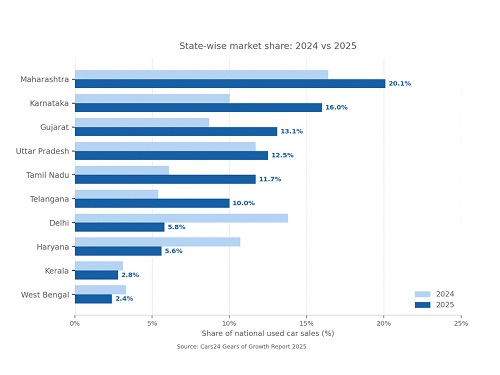
For most of the past decade, the story of India's used car market was essentially a story about its largest cities. Delhi, Mumbai, Bengaluru, and Hyderabad drove volumes. National trends were, in many ways, just metropolitan trends dressed up in aggregate numbers. That is no longer true. According to the Cars24 Gears of Growth Report 2025, Tier-2 cities now account for 62% of all used car sales in India, with metro cities contributing the remaining 38%. The centre of gravity has shifted, and it has brought with it a fundamentally different kind of buyer with different priorities, different budgets, and different ideas about what a car should do.
Source: Cars24 Gears of Growth Report 2025
Share of used car sales by geography (2025) Source: Cars24 Gears of Growth Report 2025
Metro vs Tier-2: How buyer profiles differ
Source: Cars24 Gears of Growth Report 2025
Metro buyers tend to treat used cars as a stepping stone to a better vehicle. They upgrade more frequently, are more willing to pay for convenience features like automatic transmissions, and lean toward SUVs and premium hatchbacks. For this segment, the used car market functions as an aspirational ladder.
Source: Cars24 Gears of Growth Report 2025
The Nexon is the top-selling model in both geographies, which speaks to its broad appeal across price points and use cases. But the divergence begins immediately after. Metros rank the Baleno second, a premium hatchback with feature-rich trims and strong automatic penetration. Non-metro markets place the Grand i10 second, a model valued for its simplicity, low running costs, and widespread service network.
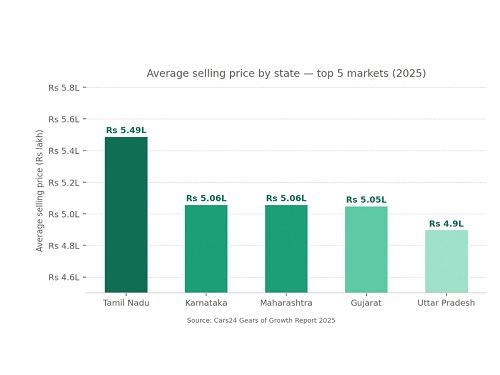
Source: Cars24 Gears of Growth Report 2025. Values in Rs lakh
Conclusion: Tier-2 India is not catching up to metros; it is building its own market
For the industry, this means the national market is becoming more resilient. No single state or city can now determine whether it has a good year. For buyers in smaller cities, it means access to a more organised, transparent, and well-stocked market than was available even three years ago.
About the Data
|
||||||||||||||||||||
|
|
|||||
|
|||||
| |||||